
I was once on top of a hill fort in Raigad, Maharashtra – one of the many built by the great Chatrapati Shivaji centuries ago. The local guide, a 14-year-old boy was telling us all about the history of this fort – how it was conquered, where the king slept, where he held court, the quarters for the women, the water storage facility, etc. It was a fascinating visit for a thoroughbred urbanite like me to see what was once a symbol of sovereignty and resistance against invaders. I felt proud to be a Maharashtrian.
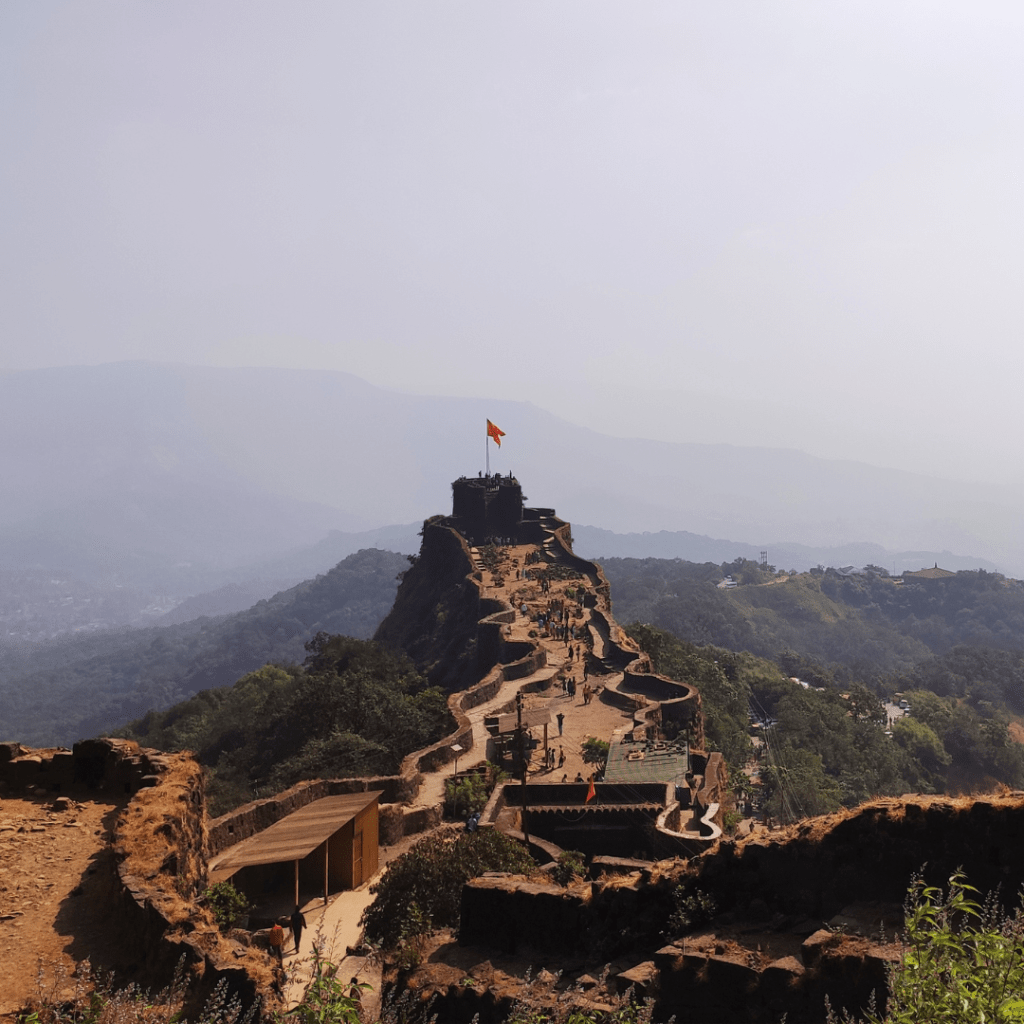
As we returned, the guide showed us a path that had 1000+ steps that connected the fort to the ground. It was as steep as it was ancient. He said every week, scores of people from rural Maharashtra make their way to the top of the hill from these very steps. They leave their homes on a pilgrimage to pay their respects to Shivaraya, the brightest light of Marathi civilization. As he said this, I watched a group of men make their way to the top with bhagwa (saffron) flags and other ritualistic items.
Travelling hundreds of kilometres with bare necessities, these young men had spent weeks of their lives honouring the legacy of the man to whom I owe my identity, language, and politics. The pride I felt just a few minutes ago was quickly replaced by a troubling question. Am I really a Maharashtrian? What have I done recently to call myself that? Compared to these young men who are so rooted in their history and icons, I felt like a cheap knock-off. I had even come up the hill in a gondola!
On my way home, we sat in an air-conditioned vehicle as we zoomed past huts and kaccha houses that lined the village landscape. We stopped in a couple of hours to pay homage to Uncle Sam at McDonald’s while my brother had an overpriced Starbucks frappuccino because “Garmi bohot hai!”. This wasn’t the first time I was escaping the reality of my country to enter the urban bubble that I was born and raised in my entire life. But it was definitely the first time I saw cracks in my assumption that I was as Maharashtrian as my cousins from Kolhapur.

Who am I really? I rarely speak Marathi with anyone other than my immediate family and my cook. Even that is interchanged liberally by Hindi and English. My Netflix and YouTube playlists have a grand total of zero Marathi series. movies or songs. I don’t blame myself on that one for reasons better suited for another article. Neither do I consume, nor do I share Marathi media. Catching glimpses of Marathi Hasyakatha while visiting my parent’s house doesn’t really count. It’s a damn shame because I literally consume more Spanish, French, Korean, and Mongolian (really) content than my own language’s content!
How did this happen!? I am 30 years old and the only time I turn on a Marathi news channel is when one of our politicians inevitably moves to the BJP after calling Modi a fascist for two decades. The last time I must’ve spoken Marathi in my workplace was in 2014 when I was arguing with someone in a warehouse. I feel illiterate while trying to read hoardings in Marathi. While I am pretty religious and visit temples twice a week, that’s more a sign of being a practising Hindu. I can’t just visit Ganpati pandals during Ganesh Chaturthi and call myself a Maharashtrian. I’ve lost my regional identity, no two ways about it. While it’s a failure on my part, it is also a reality that many young Indians are facing.
There’s a rise of young, urban Indians who start their mornings with news from Twitter, check out Instagram reels for an hour while travelling to work, and join a Zoom meeting with colleagues based out of seven different countries and three continents. These people can’t realistically see themselves as a continuation of their parents with the same tastes and preferences. Their identity is being shaped by their surroundings and the media they are consuming. Who we talk to, date, admire and get influenced by is no longer confined within the frontiers of our village. A bunch of 14-year-olds recently ran away from their homes to meet BTS in South Korea. Thankfully our authorities were not fans of the Korean pop group and promptly sent them back to their parents to face the music. When I was growing up, kids were pretending to be Shaktiman. You see what I mean?
All my friends who went abroad are still there. None of them have come back. It’s been a decade for some of them. Some of us even worked for the same company at times. They join from the suburbs of Seattle and San Diego and me from the gated colonies of Mumbai. We watch the same shows, follow the same football league and speak the same primary language – English. I understand their problems and have similar, if not the same aspirations in life. We visit the same countries for our annual vacations. Our value systems are not dissimilar and neither are our worldviews, in most cases. Heck, we share the same geo-political concerns without knowing our local municipal administrators who arguably shape our lives more than the President of Hungary and his attitude towards the EU.
I used to derisively call some of my friends MINY – Mentally In New York. These are Instagram-addicted, Zara-obsessed, Buzzfeed-reading, urban elites who walk around pretending half their city doesn’t live in slums and their mom won’t slap them senseless if they break their 10 pm curfew. Almost exclusively liberal, this group has mastered the art of delusion which is necessary to continue their lifestyle and approach to live in a country as extraordinarily complicated and poor as ours. Is it any wonder they wake up looking at the West on their phones and sleep dreaming of leaving the East? India is too unique and insular to give them what’s on offer in the West. I am not talking about earning power and infrastructure. I am talking about a certain lifestyle, culture and freedom.
People usually end up matching their external surroundings with their internal reality. Is it any wonder our people have been flocking the airports looking for a “better” life? Not to mention, the Indian diaspora has absolutely mogged every other ethnicity in the West. Not content with running their top companies, our folks are making heavy inroads into their national politics. While Rishi Sunak wasn’t voted to be the PM and Vivek Ramaswamy has a slim chance of becoming the VP, it is an incredible reality where the global Indian can almost achieve anything conceivable – not just Spelling bees.
Today, a skilled Indian can move to almost any country they want to. Depending on the prevailing political and economic climate, they can enter the country in a few years and become a positive contributing member of society. This route does not include the thousands of Indians who have allegedly entered Western countries in recent years illegally. This is about the highly educated Indian who is extremely confident in their own shoes, secure about their accent, and proud of their background, religion and unabashed ambition. They are part of the same digital circles as their global peers, and have their pulse on global pop culture, geopolitics, shared concerns and experiences. Is it a surprise we can see teenagers in the Cuffe parade marching for a #FreePalestine?

You can parachute the global Indian in New York, London or Toronto (with some winter clothing) and they will blend in without a hitch. Oh and give them a few years, and they will succeed in any given field they are part of. What’s the use of moving continents, staying away from your loved ones and not having real vada pav if you don’t obliterate your competition? You are telling me the people who have been raised on a steady diet of competing with their siblings, classmates and neighbours are not going to try to best or equal anything and everything they see on LinkedIn and Instagram?
Which takes me to my original point. There are many countries within this country. No, I am not against federalism and a strong centre the way Rahul Gandhi is. From a psychographic standpoint, India is made up of many different types of people. Diversity might be considered a strength in the West, but in India, it is our default setting. In a country with so many identities, there’s a new one (that I believe I belong to) which is rising and rising fast. It is trying to make itself heard and some people are listening to them. Not the politicians, they have their set vote banks that serve them very well.
But in the coming decades, the Global Indian will be an incredibly influential cohort that’s spread across countries and corporations in important decision-making positions that will dwarf its already outsized achievements. We are ready to try and make our mark on a global scale. Is the world ready? Are other Indians? Neither do we relate to the majority of our countrymen and nor do they relate to us in a multitude of ways. I am literally judged by some folks for watching the EPL over the IPL. At the end of the day, I am more comfortable having a conversation with someone from Sydney than someone from Solapur. This is not to say Sydney > Solapur. It’s not. It’s just that my upbringing was more Western than my parents or I realized.
Does it make me less of an Indian? Absolutely not. Less of a Maharashtrian? Maybe. Or maybe I am just a MINY.
 Pol Ke Bol!